


BBC Panorama - The Poison in Your Mouth (Continued)
BBC Panorama - The Poison in Your Mouth (Continued)
MANGOLD (BBC): Doctor, is there an overlap between the lowest figure of exposure for dentists and the highest figure for ordinary patients with quite a lot of amalgam fillings?
 ECHEVERRIA: Probably yes.
MANGOLD (BBC): And does that mean then that a lot of patients are probably suffering the same symptoms that the dentists are suffering?
ECHEVERRIA: Well that's the next research question that we need to ask ourselves, because we don't know for sure. We have indications that comparable effects are appearing just above that range. But the leading question now is whether or not we have a problem at that lower overlap level.
MANGOLD (BBC): But that means at that level the safety margin is extremely small.
ECHEVERRIA: Very narrow. Extremely narrow. That's a major concern. That's right.
(Vision cuts to other interview)
MANGOLD (BBC): Just tell me this because people will say 'ok that's bad, it takes a microsecond longer to put a pen into a hole,' does it matter?
APOSHIAN: My greatest worry would be among the children. Now children are going to school. They are being taught things. They are being taught how to handle living situations, everyday situations. They're being given information that we hope they'll keep in their minds for a better way of life. It is conceivable that as they are being educated, and as they are being trained to do something, that their training will not stay with them as long, that they may not be able to do things as quickly, and therefore they will not be able to be judged proficient in certain tasks.
(Vision cuts away from interview)
 MANGOLD (BBC): If you write to the British Dental Association here on Wimpole Street asking about the safety of amalgam fillings, they'll send you a so-called fact sheet. This is it. It covers the subject of children by stating categorically that the evidence available to the BDA doesn't justify banning the use of amalgam in young children. Yet it is precisely the young who are most vulnerable to mercury poisoning.
 These children at a Liverpool comprehensive have on average a couple of fillings each. It's easy to demonstrate how the mercury vapors escapes from their small fillings. We invited an expert to bring a mercury vapor tester to check. The air around the fillings is measured.
Even without stimulation some mercury vapor is escaping from the filling. Then the filling is rubbed to simulate chewing, brushing or grinding. This time there is no doubt that mercury vapor has begun to leak copiously. This is the actual reading as the needle goes off the scale.
(Vision cuts to schoolroom)
MANGOLD (BBC): She's only got one filling hasn't she?
TESTER: Right.
MANGOLD (BBC): And if she has eight fillings.
TESTER: It'd be eight times as much.
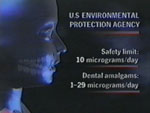 VOICE OVER: The United States authorities recommend a maximum safe mercury exposure limit of 10 micrograms a day. But scientists have discovered that dental amalgams alone can produce between1 and 29 micrograms of mercury vapor a day. So some people exceed the safety limit for mercury just with their fillings.
(Vision cuts to BDA interview)
MANGOLD (BBC): Do you believe it is safe to use amalgam in children?
JOHN HUNT (Chief Executive, British Dental Association): Yes, certainly. And I've treated my children with amalgam and I have no doubt that when they have their own children they will also.
(Vision cuts away from interview)
VOICE OVER: In Sweden, Dr Lars Friberg, the world authority on metals poisoning, remains baffled at the various attempts by dental lobbies to maintain their rearguard defense for a material whose time, he feels, has come.
(Vision cuts to Friberg interview)
MANGOLD (BBC): British dentists say that there's no evidence that it shouldn't be continued for use in children.
 Dr. LARS FRIBERG (Consultant, World Health Organization): Yes, I think there is no basis for such a statement.
MANGOLD (BBC): Are you saying children are particularly vulnerable, or what?
FRIBERG: They are definitely particularly vulnerable. We know that if you take the young child, I mean it takes a few years after birth until the brain is developed and we know that the brain in the children are much more sensitive than the adults.
MANGOLD (BBC): You don't think that putting mercury into the brain of a child is a good thing at all, do you?
FRIBERG: No I don't think so.
(Vision cuts away from interview)
 VOICE OVER: But it's not just young children at risk. Even the unborn have mercury pollution in their brains from their mother's amalgams. This evidence came to light in a study just completed by Professor Gustav Drasch, a forensic toxicologist. He examined the brains of dead babies and fetuses and found mercury deposits had crossed the placenta into their tiny skulls.
(Vision cuts to interview)
 Dr. GUSTAV DRASCH (University of Munich): I think the implications are serious. It is a question whether or not we have to restrict the application of dental amalgam to women, not only in child bearing age but even before. Because you must see that if, for instance, a girl of fifteen, she get an amalgam filling, these fillings lie in your mouths for ten years, and all the time this filling release some mercury, and if this girl go pregnant, let me say five years after, she has a mercury inlay in her mouth and the mercury goes to the baby. So really the question now being discussed in Germany today is, not to forbid it, but to speak about restriction of amalgam fillings for women from, let me say, from fifteen to fifty years.
(Vision cuts to BDA interview)
 MANGOLD (BBC): Do you believe it's safe to use amalgam in pregnant women?
PETER GORDON (Science Advisor, British Dental Association): There is no evidence to say that it's unsafe.
MANGOLD (BBC): But are you saying it's safe to use it in pregnant women?
JOHN HUNT (Chief Executive, British Dental Association): Yes, there's no doubt that the available data we have at present demonstrates that amalgam is just as safe as any other material that we may use for pregnant women.
MANGOLD (BBC): This is terribly important, isn't it? Mercury crosses the placenta and goes into the unborn.
HUNT: But you have to...Before you say it is dangerous or poses a risk, you have to say that mercury in those places is dangerous. And there's no evidence to suggest that merely because it is found in the kidneys and so on, or fetuses and young children, that it is a hazard to health.
MANGOLD (BBC): Do you think mercury, one of the most toxic metals known to man, is a good thing in the brain of an unborn child?
HUNT: There's no proven, as far as I know, there's nothing to prove that it is causing any damage.
MANGOLD (BBC): Don't you think that this is something that ought to be put into your file?
GORDON: I don't see why we should necessarily worry about the population at large if there are no proven arguments one way or the other; that the fact that it is there and detectable doesn't mean to say that it is potentially doing any damage.
MANGOLD (BBC): I have to say, gentlemen, I haven't met anybody who thinks that mercury in the brain of an unborn child is a good thing.
GORDON: But you can probably, with a correct analysis, find a whole lot of other substances in the brain that perhaps shouldn't be there.
(Vision cuts away from interview)
 VOICE OVER: As these are the men who give scientific advice to British dentists, it's not surprising that pregnant women are still treated with amalgam fillings despite the possible health hazards to their unborn babies. In Britain they're encouraged to take free treatment under national health.
Joe Rich is an ordinary NHS dentist. Like thousands of others he's been told little about the latest scientific evidence about mercury. He doesn't know that much of it points towards the health hazards of amalgam to vulnerable groups such as the expectant mother in his chair.
(Vision cuts to new interview)
 MANGOLD (BBC): You're happy to place amalgam fillings in the mouths of babies, children, and pregnant women?
JOE RICH (NHS Dentist): Indeed.
MANGOLD (BBC): No problem in that respect at all?
RICH: I have no reason to doubt the efficacy of the treatment, and that there are few if any dangers to the patient in using it.
(Vision cuts to Friberg interview)
MANGOLD (BBC): We know that the mercury goes into the brain of the unborn child. Can this, under any circumstances, be a good thing?
Dr. LARS FRIBERG (Consultant, World Health Organization): No. I would say no. I think that you should try to avoid to implant toxic metals in the mouth.
MANGOLD (BBC): Why then does an organization like the British Dental Association say that mercury is safe for everybody unless they're allergic to it?
FRIBERG: Well I don't know why they say it. That's impossible for me to answer.
MANGOLD (BBC): You've written the standard textbook on the toxicology of metals and you don't agree with them, do you?
FRIBERG: No, I don't.
(Vision cuts away from interview)
 MANGOLD (BBC): Sweden, the first country in the world whose parliament has banned amalgam. They've taken the dangers so seriously that amalgam's use will end within three years at the latest, and within six years all mercury will be outlawed. The Swedes have read the writing on the wall and decided to take action.
Faced with opposition from the dental lobbies and anxious at the potential legal implications, parliament carefully wrapped the legislation up in a total environmental package. But members of parliament who had pushed for the ban knew what the real targets were.
(Vision cuts to new interview)
MANGOLD (BBC): People say that the only reason the Swedes are banning dental amalgam is on environmental grounds. Now is that true?
 SIW PERSSON (Member of Swedish Parliament): No, really not. It's one reason, but the most important reason is, of course, a health reason.
MANGOLD (BBC): Why has Sweden been the first country to ban dental amalgam because there's still no evidence, there's no final proof, that dental amalgam actually hurts human beings?
PERSSON: We said we have seen enough. Now we have to stop it, before much more people are more sick than they are today.
(Vision cuts away from interview)
VOICE OVER: The use of amalgam in children under the age of nineteen will be totally banned exactly one year from now. All amalgam fillings for adults will cease by 1997. The Swedes are fully aware that there is still no proven evidence that dental amalgam harms humans. But they've been reading the latest evidence, and their assessment of the risk-benefit ratio has been changed by it forever. The health benefits of amalgam, they judge, are no longer worth the risks.
Now, other countries are following Sweden's lead. In Germany, amalgam is banned for patients with kidney problems and advised to be used with great caution in children and pregnant women. Austria plans to ban mercury in amalgams within six years. And in California, a new law now demands that dentists who use amalgam display a health warning to their patients.
 Germany and the headquarters of Degussa, one of the world's larger manufacturers of dental amalgam. Even they've now decided to get out of amalgam, thus abandoning nearly half their dental products turnover. They say that there are innocent commercial reasons for this, but one of their executives suggests there's prudence in the decision too.
(Vision cuts to new interview)
MANGOLD (BBC): You are saying that despite all this new scientific evidence that it happens to be a commercial coincidence that you're getting out of amalgam?
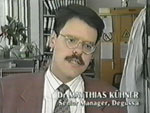 Dr. MATTHIAS KUHNER (Senior Manager, Degussa): It was a decision that was driven by business reasons.
MANGOLD (BBC): Which would include legal reasons?
KUHNER: Definitely when you are looking at a business, legal action can have an influence on your business. It can greatly increase the cost of your business if you have to take a lot of legal actions, or have to deal with legal actions, even if you are sure that in most cases, or in all the cases, you come out with being found not guilty.
MANGOLD (BBC): And finally, Dr. Kuhner, thank you for being so patient with me, in that sense surely the writing is on the wall for amalgam?
KUHNER: Well, as I said before, I feel that use of amalgam is going to decline even more in many nations.
(Vision cuts away from interview)
VOICE OVER: Instead, the company is concentrating on making composites, the plastic alternatives already used extensively in front teeth. Currently, they're not as cheap and durable as amalgams, and Degussa, like many competitors, is hard at work looking for the dream composite that will rival the cost and strength of amalgam.
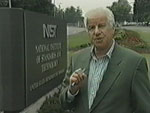 So, is there an acceptable alternative to mercury amalgam? We've learned of a scientific breakthrough of a new mercury-free alloy at this Federal research institute near Washington. But they won't let us film inside.
The truth is, how can the demise of mercury amalgam be announced without acknowledging that mercury shouldn't have been there in the first place?
The new material, wrapped in commercial secrecy behind these walls, will be hailed not as a substitute for amalgam for reasons of health, but as an improvement on it. This cover story will please the dentists and the fillings should be safe for patients too.
(Vision cuts to Eggleston interview)
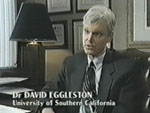 Dr. DAVID EGGLESTON (University of Southern California): The material is here and developed. It has to go through trials and research before it becomes approved, and that will take a few years.
MANGOLD (BBC): How long?
EGGLESTON: I've been told in some quarters to expect two years for that process to be completed.
MANGOLD (BBC): Will it be more expensive?
EGGLESTON: It'll be exactly the same cost, maybe even a little less expensive. It uses the same equipment for placement and actually has a superior strength once it's in place.
MANGOLD (BBC): And will it last as long?
EGGLESTON: The predictions are that it will last longer, that it has a superior strength.
MANGOLD (BBC): Well, let's get this absolutely straight. The reason this new material has been worked on is in order to eliminate mercury from the entire chemistry, yes?
EGGLESTON: There's no question. There's no incentive to develop this material other than to get rid of mercury.
(Vision cuts away from interview)
 MANGOLD (BBC): So that's the concern with which the whole amalgam issue is handled overseas. What's Britain doing? Nothing much really. We had hoped to bring you an interview with someone from the Department of Health but they refused to talk to us on camera. We would have asked them what, if anything, has changed since 1986 when they last looked at the issue and decided that there was no problem with amalgam.
Indeed, they said the controversy didn't even merit research priority. They've just handed us a four line statement. I've read it but there's nothing new in this.
But while government ignores the issue there is a new awareness in some quarters that patients need greater protection against the possible health hazards.
Stephen Challacombe is Professor of Medicine at Guys Hospital in London and one of Britain's top dentists. He has bothered to keep up with the new research and finds much of it compelling.
(Vision cuts to new interview)
MANGOLD (BBC): Are you satisfied that amalgam is safe?
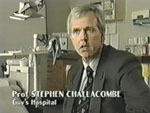 Dr. STEPHEN CHALLACOMBE (Guy's Hospital): No, I don't think so. I think the evidence over the last few years has really suggested that we should have another look at the ultimate safety of amalgams.
MANGOLD (BBC): What do you make of the official government view, the Department of Health view, which is that there's no problem and therefore it doesn't even merit the priority of further research?
CHALLACOMBE: I think things have changed. A number of very good groups in Europe, in Germany, Scandinavian countries of course, who have been very much aware of the environmental effects of mercury and have looked in some detail at possible biological effects from mercury from amalgams. I'm a researcher, I'm a clinical academic, I'm very keen that we should be absolutely sure of our facts, and there's no doubt in my mind that we should be supporting research in this and other countries. We shouldn't be left behind.
MANGOLD (BBC): And in that sense you wouldn't agree with the government position at all?
CHALLACOMBE: If the government position is still that we don't need research, no I think that's outdated.
(Vision cuts to BDA interview)
MANGOLD (BBC): Aren't you in danger of making exactly the same mistake that was made over lead, asbestos, and DDT? That we had to wait for too long, there were too many tragic side effects before the accumulation of scientific evidence showed conclusively that these were highly dangerous substances.
 JOHN HUNT (Chief Executive, British Dental Association): Well, we can only rely upon the evidence that we have to date. And I don't think that the amount of mercury that is released, and we know it's released from amalgam restorations, there's no evidence that, to date, that it does cause any trouble.
(Vision cuts away from interview)
VOICE OVER: At Murray Vimy's surgery in Calgary, a young women anxious to avoid passing mercury to any future child, has an amalgam filling extracted. Paradoxically this process has its health hazards too, because the drilling out creates a dangerous surge of mercury vapor. Hence all the protective equipment on both sides of the chair.
Extraction of fillings is a serious step unless medically indicated. Patients should consult their doctors or dentists before making a decision.
(Vision cuts to Challacombe interview)
MANGOLD (BBC): Professor, can I ask you to, in the briefest and simplest way, give advice to people who will have seen this film and who will wonder if they should take their amalgam fillings out. What is your considered advice?
CHALLACOMBE: I think it would be premature for people to replace their amalgam fillings. No, the answer is do not rush to your dentists to have your amalgam fillings replaced. I think there is clearly a need for further research and when all that is through, in the long term there may be different advice. But there is a danger in doing more harm than good at this stage, so do not rush out and have your amalgam fillings replaced.
 VOICE OVER: In the dark places where men work with mercury, turning old fillings into new, they treat the volatile metal with great respect. Yet those charged with the responsibility of keeping dentists and their patients informed deny these realities by insisting there is still no final proof of amalgam's harm to humans. But in science, absence of proof is not proof of absence. Ask the men who take the risks.
END
Also make sure to read these books: Poison in Your Teeth: Mercury Amalgam (Silver) Fillings...Hazardous to Your Health! and Mercury Detoxification by Tom McGuire
Continue to:


My Books

